


Communication Coach vs. Executive Coach
October 13, 2026 Updated: November 10, 2026

A mirror and a window have a curious thing in common. Both are made of glass, yet one reveals what has been there all along, waiting to be noticed, while the other invites us to look further, take in the wider view, and discover what lies beyond.
And sometimes, all it takes is a different view to notice something we’ve been missing.
Communication coaching and executive coaching offer two such perspectives. One helps people become more aware of how they express themselves and connect with others. The other helps leaders see the bigger picture, navigate challenges, and understand their impact on the people around them.
Both have their place in helping people grow. The interesting part is knowing when each is needed.
A Closer Look: What Does a Communication Coach Do?
Every organization has people with wonderful ideas who sometimes struggle to make themselves heard.
Perhaps a manager finds it difficult to speak confidently in leadership meetings. Or a talented professional has all the right information but struggles to turn it into a story that captures people’s attention.
A communication coach helps people understand how they come across to others and develop the skills to communicate more effectively.
Communication coaching commonly focuses on:
- Executive presence and public speaking
- Storytelling and persuasive communication
- Active listening and interpersonal skills
- Giving feedback and handling difficult conversations
- Adapting communication to different audiences
At Ariel, communication development draws on theatre-based techniques and the proprietary PRES model: Present, Reaching Out, Expressiveness, and Self-knowing. Through experiential learning and practice, professionals discover how small changes in their presence and communication can make a meaningful difference.
And these changes often find their way into everyday working relationships. A manager who listens more thoughtfully may encourage quieter team members to contribute. A leader who tells a compelling story can help people understand where the organization is headed.
The Wider View: What Does an Executive Coach Do?
Leadership has a way of changing the view as people move into bigger roles. A manager who once made decisions for a small team may suddenly find themselves responsible for an entire department. The challenges become more complex, the decisions carry greater weight, and familiar ways of working may need to change.
An executive coach helps leaders navigate these responsibilities while developing a deeper understanding of themselves and their impact.
Executive coaching typically focuses on:
- Strategic thinking and decision-making
- Leadership effectiveness and self-awareness
- Building and developing teams
- Managing change and uncertainty
- Delegation and accountability
- Stakeholder relationships and influence
Rather than arriving with a ready-made collection of answers, an executive coach helps leaders reflect on their experiences, recognize patterns, and explore different approaches.
Ariel’s executive coaching follows a structured eight-step process that includes feedback, stakeholder alignment, personalized development, and progress measurement. Its coaches bring real-world business experience to these conversations, offering an understanding of the challenges leaders encounter in their roles.
Two Perspectives: Communication Coach vs. Executive Coach
While both approaches encourage professional growth, they focus on different aspects of development.
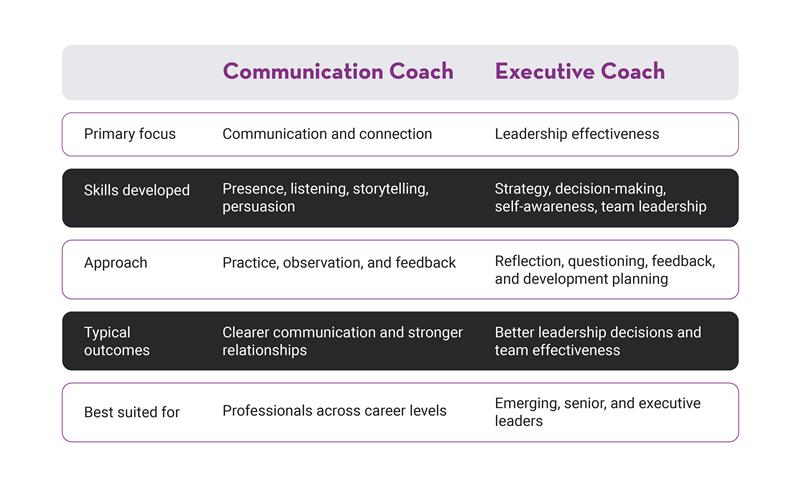
Of course, people and their development needs rarely fit into such neat categories.
Where Communication Coaching and Executive Coaching Meet
Consider a leader preparing their team for a significant organizational change.
An executive coach might help them think through the challenges ahead, understand the concerns of different stakeholders, and decide how best to guide their people through uncertainty.
A communication coach might help them explain the change with clarity, listen to questions, and create space for honest conversations.
Both approaches contribute to the same leadership moment, each bringing a different kind of support.
This overlap is important because communication is woven into almost everything leaders do. Even the most carefully considered decisions need to be understood by the people responsible for bringing them to life.
How to Choose the Right Coaching Approach
A useful place to begin is with the development need.
When professionals struggle to communicate ideas, influence stakeholders, or present with confidence, communication coaching can offer focused support.
When evaluating this kind of support, Top 8 Questions to Ask When Hiring a Communications Coach offers useful questions to consider, including the coach’s experience, process, and fit.
When leaders are preparing for greater responsibilities, navigating complex relationships, or strengthening their strategic capabilities, executive coaching may be more appropriate.
The wider organizational context matters, too. Developing communication skills across a group of managers may call for a different approach than supporting a senior executive through a leadership transition.
Sometimes, combining both approaches offers the most valuable opportunity for growth.
A Little Perspective Goes a Long Way
At Ariel, communication and leadership development are closely connected. Our communication programs help people strengthen their presence, tell meaningful stories, and build authentic relationships. Our executive coaching helps leaders develop awareness, judgment, and capabilities to guide their organizations forward.
And perhaps that’s what makes coaching so valuable. Like a mirror or a window, it offers a different way of seeing things. Sometimes, that means noticing something about ourselves. Sometimes, it means discovering possibilities we hadn’t considered.
Either way, a little perspective can go a long way. Whether it’s helping someone communicate with greater confidence or supporting a leader through complex decisions, the right kind of coaching can make a meaningful difference. And when people grow in these ways, the benefits often reach beyond the individual, shaping how teams connect, collaborate, and move forward together.

Subscribe to newsletter
"*" indicates required fields